What Are B2B Ads? (And Why They’re Different from B2C)
B2B advertising refers to paid promotions aimed at business buyers rather than individual consumers. Unlike B2C transactions, where a single person often makes a quick purchase decision, B2B campaigns must influence multiple stakeholders across a longer buying cycle. As a result, the strategies, channels, and success metrics look very different from consumer advertising.
Why B2B Buying Is More Complex
B2B marketing requires addressing several decision makers, building greater trust, leaning on thought leadership, and managing longer, harder-to-measure sales cycles. These differences have three key implications for how you plan and run paid campaigns:
- Longer buying journeys and multiple decision makers: Business purchases are typically larger, negotiated, and involve several stakeholders across departments. Consequently, ads need to nurture leads over weeks or months and speak to the needs of executives, finance teams, and technical buyers alike.
- Greater emphasis on trust and thought leadership: Because a poor purchase affects an entire organisation, B2B brands must demonstrate expertise and value. Content must therefore educate rather than entertain, and it must differentiate the brand in a credible, evidence-based way.
- Complex measurement: B2B conversions often happen offline via sales teams, so attributing revenue to specific ads is harder than in B2C. Successful programmes consequently integrate ad data with CRM and pipeline metrics, rather than relying solely on clicks or form fills.
Platforms used for B2B advertising
The channel mix for B2B is distinct from consumer advertising, and choosing the right platform makes a significant difference. LinkedIn stands out as the only B2B-focused social platform with more than one billion members across 200 countries, including executives from every Fortune 500 company. Moreover, its sessions grew 11% year over year in 2025, reflecting strong and rising professional engagement.
Google Search, meanwhile, captures high-intent queries at the moment buyers are actively researching solutions. YouTube, as part of the Google/Alphabet family, supports video demos — an increasingly important format, given that 29% of B2B buyers (including 25% of enterprise-level buyers) search YouTube for demos or reviews, and 69% say product demos influence their final purchase decision.
Emerging and Supporting Channels
Beyond LinkedIn and Google, Meta platforms (Facebook and Instagram) offer broad reach and serve as effective retargeting channels during long buying cycles. In addition, programmatic display and connected TV (CTV) advertising are gaining traction. LinkedIn’s CTV ad format, for example, delivers 300% better audience targeting than traditional television, making it a powerful tool for reaching senior decision makers at scale.
Why Most B2B Ads Underperform
Despite large budgets, many B2B advertising programmes fail to deliver measurable pipeline growth. In most cases, the root causes are strategic rather than technical. Common pitfalls include:
- Poor targeting and ICP misalignment: Without a clear ideal customer profile (ICP), campaigns show ads to the wrong job titles or industries, wasting spend on audiences that will never convert.
- B2C-style creative: Ads designed for consumers — with emotional storytelling or broad messaging — don’t resonate with business buyers who need evidence and ROI justification.
- Lack of conversion tracking: When CRM or marketing automation data isn’t integrated, marketers optimise for vanity metrics such as clicks or form fills, rather than actual sales opportunities.
- No full-funnel strategy: Focusing only on bottom-funnel lead generation ignores the importance of awareness and consideration phases. B2B buyers consume demos, reviews, and thought leadership content throughout a long journey.
- Limited optimisation cadence: B2B teams often lack the resources to continuously test creatives, audiences, and budgets. Platforms like LinkedIn and Meta, however, reward consistent iteration with improved performance over time.
The Resulting Pain Points for Marketing Leaders
These missteps translate directly into pain points for CMOs and marketing leaders — low ROI, overwhelmed teams, rising platform complexity, and concerns about wasted budgets. A performance-driven agency therefore addresses these issues through structured strategy, rigorous testing, and clear accountability.
What a Results Driven B2B Paid Media Strategy Looks Like
Building a scalable B2B advertising programme requires four interconnected pillars. Together, they ensure your spend reaches the right people, with the right message, at the right stage of the buying journey.
- Audience & ICP mapping
Start with a detailed ICP covering job titles (such as CMOs, VPs, and CEOs), industries (SaaS, technology, and growth-stage firms), and regions (Europe and the UAE). Use LinkedIn’s targeting options to combine company size, seniority, and interests. Furthermore, extend this segmentation into account-based marketing (ABM) and intent-based audiences, so your ads reach decision makers precisely when they are actively researching solutions. - Channel strategy
Rather than spreading budget thinly across every platform, allocate it based on where your ICP is most active:
- LinkedIn Ads: Given its professional user base, LinkedIn should be your primary channel. It offers multiple campaign objectives — lead generation, website conversions, video views, and thought leader ads — allowing you to tailor campaigns across the funnel. Its CTV ad format additionally provides 300% better targeting than traditional TV.
- Google Search and YouTube: Capture high-intent searches on Google and deliver detailed product demos on YouTube. Remember that 29% of B2B buyers search YouTube for demos or reviews, and 69% say product demos influence their decision.
- Meta (Facebook and Instagram): Use Meta platforms for retargeting and mid-funnel engagement. They offer cost-efficient impressions and help maintain brand familiarity during long buying cycles.
- Programmatic and CTV: For broader awareness, leverage programmatic display and LinkedIn’s connected TV ads to reach senior executives at scale.
3. Creative & messaging alignment
Align messaging with the priorities of ROI-focused decision makers. B2B buyers value demonstrations, case studies, and educational content above all else. Long-form video is particularly powerful, given that 69% of B2B buyers report that demos influenced their purchase decisions.
Additionally, incorporating employee advocacy can dramatically amplify your reach. Employee-shared posts generate up to 200% higher click-through rates and 700% more engagement than company posts, while delivering equivalent impressions at a fraction of the cost. Encouraging your executives to sponsor content as thought leader ads on LinkedIn therefore builds trust and drives measurably higher engagement.
4. Measurement & optimization framework
Implement robust conversion tracking using LinkedIn’s Conversion API, Google Ads offline conversion imports, and CRM integrations. Optimise campaigns on a weekly basis, testing creative formats, headlines, and audience segments. Social media ad costs typically range between $4 and $10 CPM across major platforms, and CPMs are rising. Consequently, consistent testing ensures your spend remains efficient as competition increases.
In House vs. Marketing Agency for B2B Ads
Running B2B ads in-house or partnering with an agency each has its pros and cons. The following table summarises the key differences:
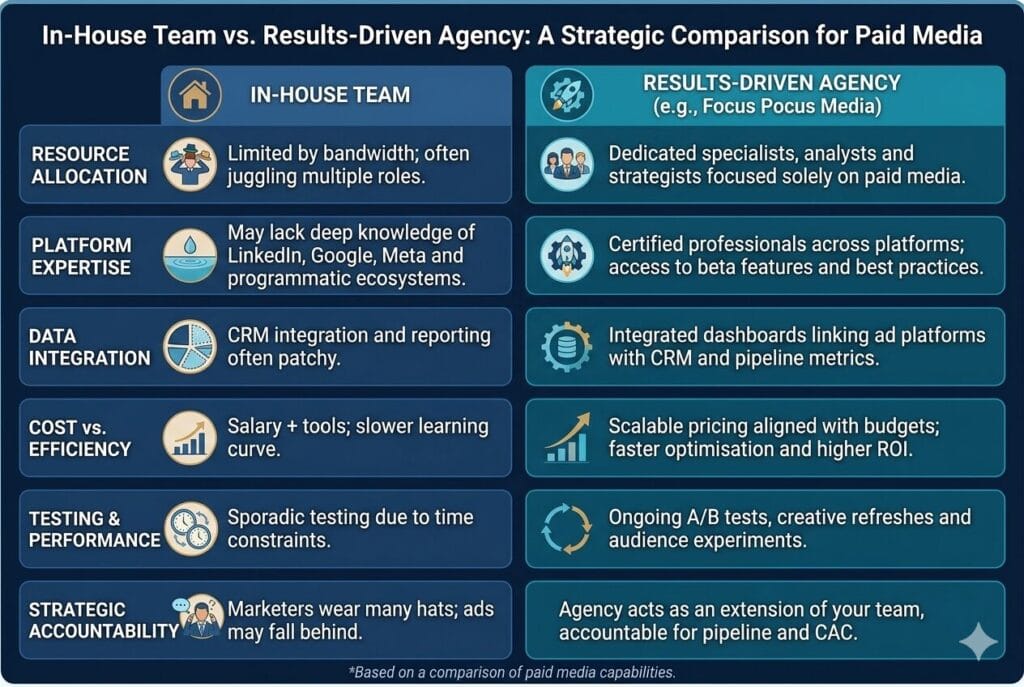 Positioning Focus Pocus Media as an extension of your marketing team emphasises flexibility, transparency, and performance accountability. Unlike generic digital agencies, we specialise in B2B and SaaS advertising and integrate seamlessly with your CRM to optimise revenue outcomes.
How to Choose the Right Business to Business Marketing Agency
Not all agencies are built for the complexity of B2B buying cycles. When evaluating potential partners, therefore, look for the following:
- Proven case studies and testimonials: Ask for documented results showing improved cost per lead and pipeline growth. Agencies should demonstrate campaigns on platforms like LinkedIn and Google and show how they influence real revenue — not just clicks.
- Clear ROI benchmarks: Leading agencies set and meet specific KPIs (qualified leads, pipeline contribution, CAC) rather than optimising for vanity metrics.
- Transparent reporting: You should have access to dashboards and weekly or monthly reporting, plus regular strategy sessions to review performance together.
- Martech and CRM integration: Ensure the agency can connect campaigns to your CRM and marketing automation platform, enabling full-funnel attribution.
- Flexibility and collaboration: Choose a partner willing to adjust strategy based on test results and changing market conditions.
- Experience managing $5k–$100k monthly budgets: Agencies like Focus Pocus Media have experience scaling budgets across Europe and the UAE, optimising spend across channels while maintaining ROI.
Checklist for Selecting a B2B Ads Agency
- Demonstrated B2B case studies and SaaS expertise
- Access to LinkedIn, Google, Meta, and programmatic certifications
- Ability to integrate with your CRM and provide pipeline reporting
- Transparent pricing and performance benchmarks
- Flexible contract terms and collaborative team alignment
- Supports budgets from $5k to $100k/month and adapts as you scale
Budgeting for B2B Ads: What to Expect
Ad budgets vary widely by industry and growth stage. Nevertheless, several core principles apply regardless of the size of your programme.
Testing, Scaling, and Channel Allocation
First and foremost, plan a testing period. Expect to invest consistently for at least 3–6 months to allow algorithms to learn and to collect sufficient conversion data for optimisation. In addition, evaluate campaigns based on cost per qualified lead (CPL) and pipeline contribution rather than raw CPL or click-through rate alone — because long buying cycles mean leads may convert months after the first interaction.
When allocating spend by channel, social media ad costs typically fall between $4 and $10 per thousand impressions (CPM). LinkedIn often carries higher CPCs, but it delivers higher-quality leads thanks to its professional audience. By contrast, retargeting on Meta or programmatic channels can reduce costs and support mid-funnel nurture more cost-effectively.
Attribution and Preventing Wasted Spend
Monitor frequency and saturation carefully, as over-exposure leads to ad fatigue and wasted spend. Use platform frequency caps and rotate creative regularly to stay fresh. Furthermore, address attribution early by connecting your ads to your CRM and marketing automation platform. This allows you to see precisely which leads convert — and prevents overspending on channels that drive clicks but not pipeline.
By working with a performance-driven partner like Focus Pocus Media, your budgeting process becomes data-led: we plan tests, reallocate spend quickly, and provide clear ROI benchmarks at every stage.
Case Driven Results: What High Performing B2B Ads Deliver
A results-driven B2B advertising programme ultimately delivers outcomes that matter to executives. Specifically, you can expect the following improvements across the funnel:
- Improved cost per qualified lead: Better audience targeting and creative testing reduce wasted clicks and drive down CPL. Employee advocacy alone can boost click-throughs by 200% and engagement by 700%.
- Higher lead quality and sales alignment: Ads mapped to ICPs ensure leads match your ideal customers. Moreover, integrating ad data with CRM helps sales teams prioritise opportunities more effectively.
- Measurable pipeline growth and optimised CAC: With conversion APIs and offline conversion imports, marketers can see exactly how LinkedIn and Google campaigns influence revenue — enabling continual optimisation and more efficient customer acquisition costs.
- Thought leadership and trust: Video demos and thought leader ads build authority. Given that 69% of buyers are influenced by product demos, educational creative is a direct driver of pipeline growth.
A Real-World Example
To illustrate, consider a SaaS company investing €10k/month across LinkedIn, Google Search, and YouTube. By implementing ABM targeting on LinkedIn, retargeting site visitors on Meta, and running YouTube demos, they see qualified lead volume increase by 45%, pipeline contribution double, and CAC drop by 25%. These results don’t happen overnight. However, they are consistently achievable when strategy, creative, and measurement are tightly aligned.
FAQ
What platforms work best for B2B ads?
LinkedIn should be the cornerstone of any B2B advertising strategy, as it’s the only B2B-focused platform with more than one billion members worldwide and executives from every Fortune 500 company. Its sessions increased 11% year over year in 2025. Additionally, complement LinkedIn with Google Search and YouTube for high-intent capture and product demos — since 29% of B2B buyers use YouTube during their research. Use Meta platforms for retargeting and awareness support.
How long does it take to see results from B2B ads?
B2B buying cycles are considerably longer than B2C. As a result, expect to invest consistently for 3–6 months before seeing meaningful pipeline impact. Multiple stakeholders must evaluate the solution, and leads often convert weeks or months after their first ad interaction. Consistent optimisation and full-funnel measurement are therefore essential throughout the process.
What is a good cost per lead (CPL) for B2B paid ads?
CPL varies significantly by industry, deal size, and funnel stage. Rather than chasing the lowest CPL, focus instead on cost per qualified lead and downstream metrics such as pipeline contribution and customer acquisition cost. Social media ad costs typically range from $4–$10 CPM; budgets of $5k–$50k per month allow ample room for both testing and scaling.
Should SaaS companies outsource paid media?
If your internal team lacks platform expertise or bandwidth, partnering with a specialised B2B agency can significantly accelerate growth. Agencies offer certified specialists, advanced tools, and continuous testing, acting as a genuine extension of your team. This is especially valuable when managing multi-channel budgets, integrating data with CRM, and reporting on pipeline metrics over long buying cycles.
Conclusion
B2B advertising isn’t about vanity metrics — it’s about creating measurable business growth through a structured, full-funnel strategy. By understanding how B2B buying differs from B2C, prioritising platforms like LinkedIn, aligning creative with the needs of multiple stakeholders, and integrating ads with your CRM, you can turn paid media into a predictable revenue engine. Focus Pocus Media specialises in performance driven B2B advertising for SaaS and growth-stage companies across Europe and the UAE. Ready to transform your paid media programme? Book a strategy consultation or request an audit today to start planning your scalable growth.
References
All statistics and platform data cited in this article are sourced from the following Hootsuite research guides:
1. B2B Social Media Marketing: 14 Strategies for Leads and Reach — Hootsuite
2. Social Media Advertising: Cost, Benefits, and Tips for 2026 — Hootsuite